
Optimal CIP Cleaning 8: CIP maintenance
29 October 2025
What maintenance on CIP and process installations really makes a difference?
In food and pharmaceuticals, reliability isn’t a nice-to-have, but a prerequisite. CIP (Cleaning-in-Place) and process installations must not only be clean, they must also perform predictably.
Smart maintenance of your CIP prevents product loss, unplanned downtime, and hygiene risks.
And not to forget: you extend the lifespan of critical components.
Seats & Seals: Small Parts, Big Impact
Valves, pumps, and heat exchangers rely on seats and seals to remain leak-tight and hygienic. Chemicals, temperature, CIP cycles, and mechanical stress accelerate wear.
How do you prevent problems with seats and seals?
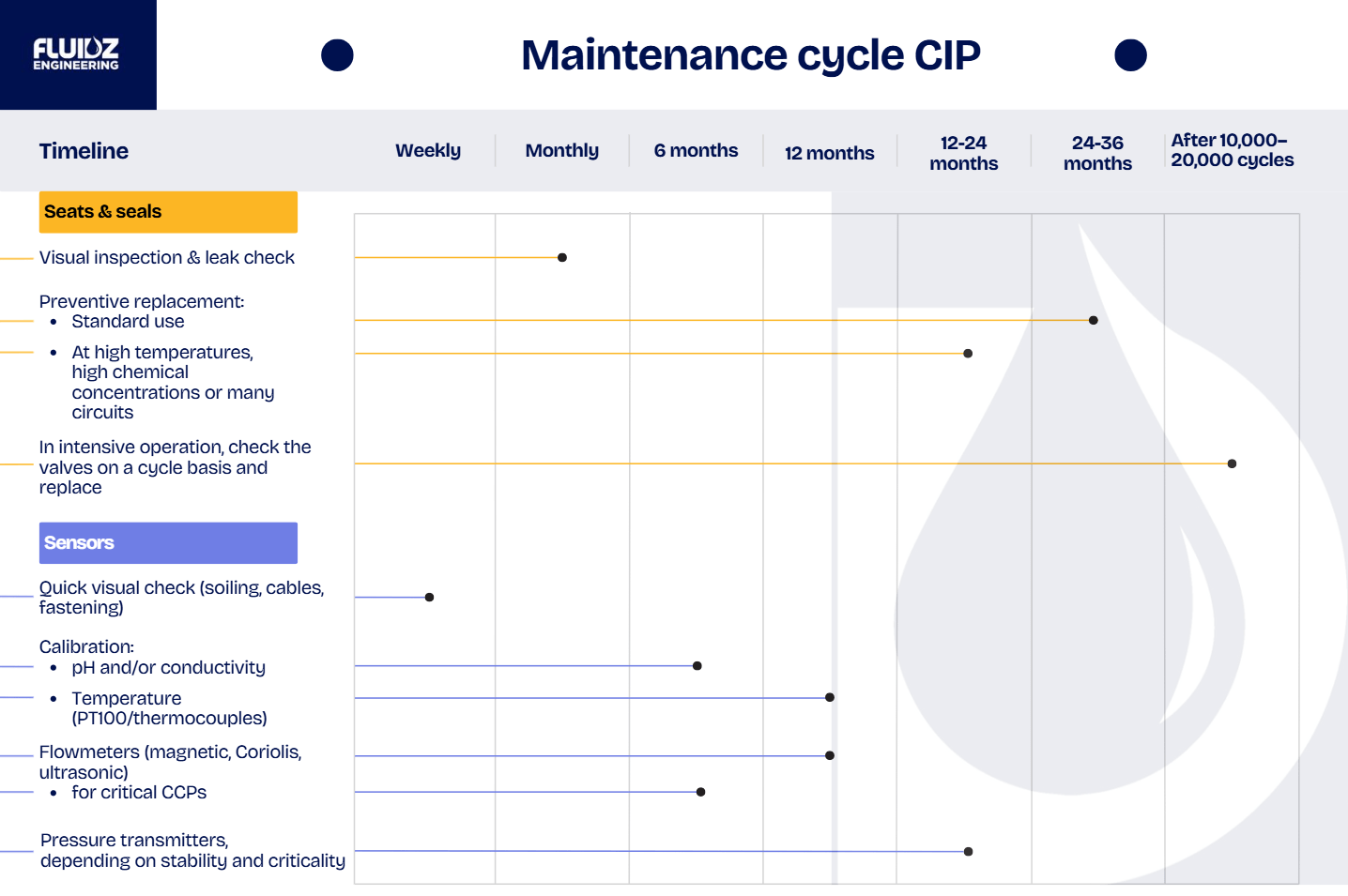
- Perform a visual inspection and leak check monthly.
- Replace preventatively every 24–36 months for standard use.
- For high temperatures, high chemical concentrations, or frequent switching: every 12–24 months.
- For intensive use: check valves for 10,000–20,000 cycles and replace setwise.
- Always use original spare parts.
Why is timely replacement so important?
Seals and seals (often elastomers such as EPDM, FKM, FFKM, or PTFE compounds) age due to alkalis, acids, oxidizers, steam, temperature spikes, and mechanical stresses. They harden and can develop microcracks.
Sounds harmless, but these cracks cause microleaks, product intrusion, and hidden areas where biofilm can accumulate.
The result: a risk of contamination and a CIP that doesn’t clean completely. By replacing them on time, you prevent this domino effect.
Practical tips:
- Inspect with a magnifying glass or endoscope. Pay attention to edges, impressions, and changes in gloss.
- Compare with a new part next to it as a reference.
- Record batch/compound and storage conditions (dark, dry, <25°C) to limit aging in the warehouse.
- Sensors: Measuring (and checking) is knowing
Sensors are the nervous system of your process control. Small deviations in pH, conductivity, temperature, flow, or pressure result in incomplete cleaning or product deviations.
Guidelines for reliable sensors:
- Quick visual check (contamination, cables, mounting): weekly.
Calibration:
- pH & conductivity: every 6 months
- Temperature (PT100/thermocouples): annually
- Flowmeters (magnetic, Coriolis, ultrasonic): 12 months
For critical CCPs: 6 months - Pressure transmitters: 12–24 months (depending on stability/criticality)
How to make maintenance smarter:
- Planned + condition-based: combine fixed intervals with signals from the field (leakage, trending, alarms).
- Setwise replacement: replace seals per kit to prevent asymmetric wear. Adjust material where necessary (e.g., FKM ↔ EPDM depending on medium/temperature).
- Check the CIP result: periodic swabs/ATP, conductivity curves, and temperature profiles demonstrably maintain your cleaning performance.
In short: good maintenance of your CIP ensures hygiene, higher uptime, and a lower total cost of ownership.
Curious about the status of your system?
Start with a quick audit of seals and sensors: the smallest components often yield the greatest benefits!
Prefer to outsource?
Let us know. We’re happy to help.