
Knowledge base
CIP systems in the food industry
What is a CIP system within food processes?
A CIP system (Cleaning In Place) is an automated cleaning system for hygienically designed process installations in the food industry. The system cleans product contact parts such as pipes, tanks, valves, pumps and heat exchangers without disassembly, with controlled parameters such as time, temperature, flow, concentration and turbulence.
Why is CIP essential in the food industry?
CIP is essential due to:
- Strict food safety and hygiene requirements
- Prevention of microbiological contamination
- Allergen control
- Reproducible and validable cleaning processes
- Comply with HACCP, BRC, IFS and FSSC 22000
Which process parameters determine the effectiveness of CIP?
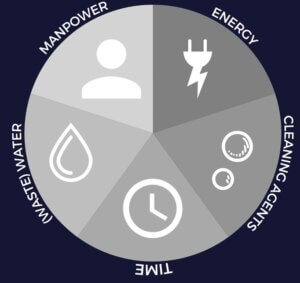
Cleaning effectiveness is determined by the Sinner circle:
- Time (contact duration)
- Temperature
- Chemistry (type and concentration of cleaning agent)
- Mechanical action (flow, speed, turbulence)
Optimization is a balance between these four factors.
What cleaning media are used in food-CIP?
Commonly used media are:
- Water (cold, warm, hot)
- Alkaline cleaners (e.g. NaOH for fats and proteins)
- Acidic cleaners (e.g. nitric or phosphoric acid for mineral deposits)
- Disinfectants (e.g., PAA or steam, if applicable)
The choice depends on product type and contamination. Get good advice in this area from your own hygiene partner.
What are typical CIP configurations in the food industry?
Common configurations include:
- Single-use CIP (lost cleaning)
- Recovery CIP (reuse of lye and/or acid)
- Central Multi-Line CIP Systems
- Decentralized or satellite CIP for specific processes
The configuration affects water consumption, chemical consumption and complexity.
What role does flow and speed play in CIP cleaning?
Sufficient turbulence is required for effective cleaning :
- Typical ≥ 1.5–2.0 m/s in pipes
- Correct sizing of pumps and pipes is crucial
- Blind spots, long pipes and low flows reduce cleaning effectiveness
Hygienic design according to EHEDG is essential here.
How is a CIP process monitored and controlled?
CIP systems use sensors and automation, such as:
- Conductivity measurement (chemical concentration)
- Temperature sensors
- Flowmeters
- Pressure sensors
- PLC/SCADA control with recipes
All parameters are logged for traceability.
How is CIP validation and verification carried out in the food industry?
In the food industry, this is done through:
- Cleaning validation at commissioning
- Calibration sensors
- Periodic verification
- ATP measurements
- Microbiological swabs
- Spoelwateranalyse
Validation supports audits and quality assurance.
How does CIP contribute to allergen control?
CIP is an important part of allergen management:
- Specific CIP recipes per product group
- Breakdown of allergens through oxidation
- Extended rinsing and cleaning steps
- Allergen Testing Verification
- Vastlegging in HACCP-procedures
Insufficient CIP can lead to cross-contamination.
How can water, energy and chemical consumption be optimized?
Optimization can be achieved by:
- Reuse of final rinse water as pre-rinse water
- Recovery tanks for lye and acid
- Online conductivity control
- Heat recovery
- Data-analyse van CIP-logs
This reduces costs and environmental impact.
What materials are used for food CIP systems?
Typical material choices are:
- RVS 316L (product contact)
- EHEDG, 3A, FDA and EU 1935/2004 compliant seals
- NBR, EPDM, FKM of PTFE pakkingen
- Hygienic valves and connections
Choice of material affects lifespan and cleanability.
What are common mistakes or underestimated issues in CIP systems in food?
Common issues include:
- Insufficient flow or too low temperature
- Poor pipe design (dead zones)
- Wrong chemical concentrations
- Missing validation or documentation
- Overly complex CIP recipes without necessity
These lead to an increased risk of contamination, contamination and contamination.
What standards and guidelines must a food CIP system meet?
Depending on application and market:
- EHEDG-richtlijnen
- HACCP
- BRC / IFS / FSSC 22000
- EU Regulation 852/2004
- Internal company standards
The CIP design must be adapted to this.
Is customization necessary for food CIP systems?
In most cases, yes, because of:
- Product specificity (fat, sugar, protein)
- Plant capacity and layout
- Allergens and product changeovers
- Integration with existing installations
We have standard modules that we can configure to customer requirements.